Your vitals chart themselves. Now your meds do too.
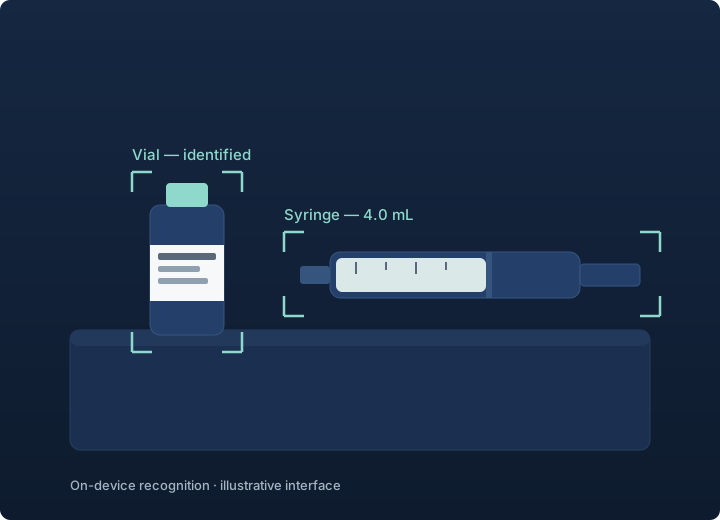
Operis is building ambient medication intelligence — smart glasses and on-device AI designed to recognize vials, syringes, and doses and produce the medication record on their own. No clicks. No scanning. Nothing asked of the clinician.
NIH STTR awardNational Institute of Biomedical Imaging and Bioengineering, with the University of Washington
Peer-reviewed foundationBuilt on research published in npj Digital Medicine
A decade in the ORBuilt by the team behind Vigilant, whose anesthesia labels run in many of the largest U.S. health systems
Private by designThe camera watches the tray, not people. Processing happens on-device, with no cloud video pipeline.
The problem
The last unautomated record in medicine
During surgery, one clinician selects, prepares, administers, and documents medications — alone, in real time, while doing another job: taking care of the patient. Vital signs have streamed into the record automatically for decades. Medications still travel by hand and memory.
That gap has a price. Documentation is incomplete in ways everyone downstream inherits: reconciliation that doesn't reconcile, 340B claims that are hard to defend, and a record that depends on recall at the end of a case.
The record shouldn't depend on memory. We're building the system that removes the need.
How it works
Wear the glasses. That's the whole workflow.
See
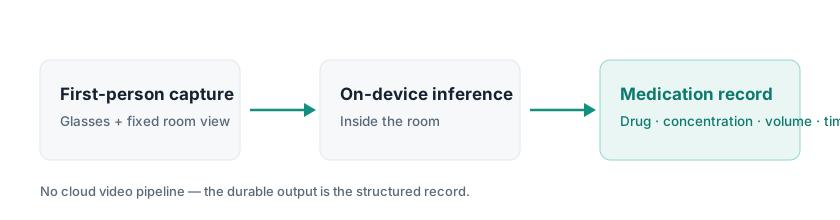
Lightweight smart glasses capture the medication workspace from the clinician's own point of view — vials and syringes at the moment of handling.
Understand
On-device AI is designed to identify the drug, concentration, and volume at the drug tray, where the work happens — with no cloud video pipeline.
Record
The system produces what hospitals need and clinicians hate producing: EMR documentation, dispensing-cabinet reconciliation support, and a defensible 340B record.
Operis launches as documentation support: it does not direct care, and it does not intercept clinical decisions. Real-time safety alerting follows a defined regulatory pathway on our roadmap; launch does not depend on it.
Who it's for
Built for the people who own the problem
Health systems
The medication documentation gap shows up three ways: incomplete administration records, 340B claims that are hard to defend, and reconciliation that consumes pharmacy time. Operis is designed to close the record — and it asks nothing of your anesthesia providers, employed or contracted.
Be a founding site in a new category. Operis pilots come with a research agenda worth publishing: validation studies with co-authorship, resident QI projects, and an IRB pathway we've already mapped.
You didn't train for a decade to do data entry. Operis is being designed to produce the documentation while you take care of the patient — and if you want a hand in shaping what it must prove, there's a seat at the table.
First the operating room. Then everywhere a drug moves.
The OR is the hardest capture environment in the hospital — which is exactly why we started there. The same intelligence being built to understand anesthesia medication work extends to sterile compounding, controlled-substance handling, and every point where human hands touch high-stakes medications.
Founding site conversations are underway with a small number of institutions. The live system — vial and syringe identification and volume measurement — debuts at ANESTHESIOLOGY 2026 in San Diego, October 16–20.