Technology
Seeing is the system.
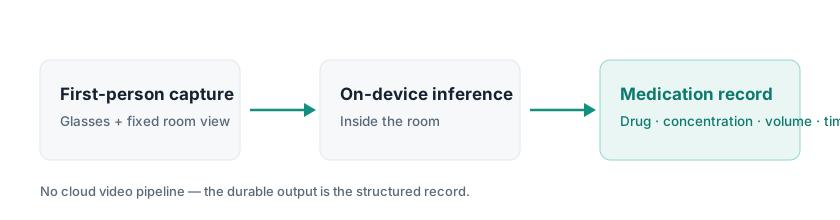
Operis turns the medication workflow itself into the record. Smart glasses capture what the clinician's hands are doing; on-device AI is built to understand it; the documentation is designed to write itself. No clicks, no scanning, no cloud video pipeline.
How it works
The camera goes where the work goes
Medication work happens close-in: hands, vials, syringes, a label read at arm's length. A room camera alone watches that work from across the OR, frequently occluded by the one obstacle that never moves — the clinician's own body.
Glasses solve the occlusion problem by construction. The wearer's line of sight is the camera's line of sight: if the human can see the label to do the task, so can the system. A fixed room view complements the wearable, maintaining continuity of the workspace when the wearer looks away. The wearable reads; the room view keeps the thread.
We didn't just put a camera in the room. We put one where the room's attention already is.
On-device privacy
The room sees everything. The cloud sees nothing.
AI inference runs on an edge device inside the room — there is no cloud video pipeline to secure, audit, or breach. The system's durable output is a structured medication record: drug, concentration, volume, time.
- The camera watches the tray, not people. Its task is reading labels and measuring volumes; there are no patient identifiers in its field of view by design.
- The durable output is the structured record. Video handling, retention, and access are governed by each site's data agreement.
- Built for HIPAA-covered environments from day one. Minimum-necessary data flows, standard business-associate agreements, and one PHI boundary — where records are written into the EMR — designed in from the first architecture review.
The label advantage
We spent a decade putting structure into the OR. Now we read it back.
Operis is built by the team behind Vigilant, whose anesthesia medication labels run in many of the largest U.S. health systems. Those syringe labels are machine-readable — drug identity and a visual reference mark in one print — designed to make syringes carrying them fast to recognize.
Everything else — vials, ampoules, unlabeled preparations — runs our open-world recognition stack. The system is label-agnostic by design: structured labels accelerate it, but nothing depends on them.
Competitors start with an unconstrained vision problem. We start with a decade-old head start.
Integrations
The paperwork, produced by observation
- EMR documentation — records of administration, built to be complete for every case.
- Dispensing-cabinet reconciliation — support for making ADC counts (Pyxis, Omnicell) match what happened.
- 340B compliance records — a defensible chain of record for eligible doses.
Designed to deliver into the EMR workflow you already run and to reconcile against dispensing-cabinet exports — integration with the systems you already run.
Operis launches as documentation support: it does not direct care or intercept clinical decisions. Real-time safety alerting follows a defined 510(k) pathway on our roadmap; launch does not depend on it.
Tiers of certainty
Graceful by design
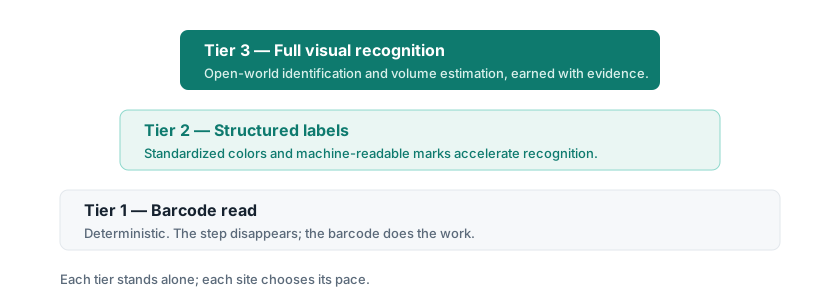
Medication vision decomposes into tiers: a barcode read is deterministic; standardized label colors and machine-readable marks come next; full visual recognition and volume estimation sit at the top. A site can start at the most conservative tier and still remove the documentation step — everything above it is earned with evidence, at the pace the institution chooses.
A system that compounds
Every collection makes it better
Recognition in real clinical environments is earned with data. Our training corpus grows through consented research collections and structured data partnerships — real medication events across drug classes, lighting, hands, and habits — under explicit agreements, with our academic and founding partners. Each collection strengthens recognition for every site that follows.
The intelligence is the product, so as clinical-grade hardware evolves, Operis moves with it.